Our Story
A farm we decided to build the slow way.
Not an inherited estate or a corporate project. A family betting on an old idea: land farmed as one living system feeds people better.
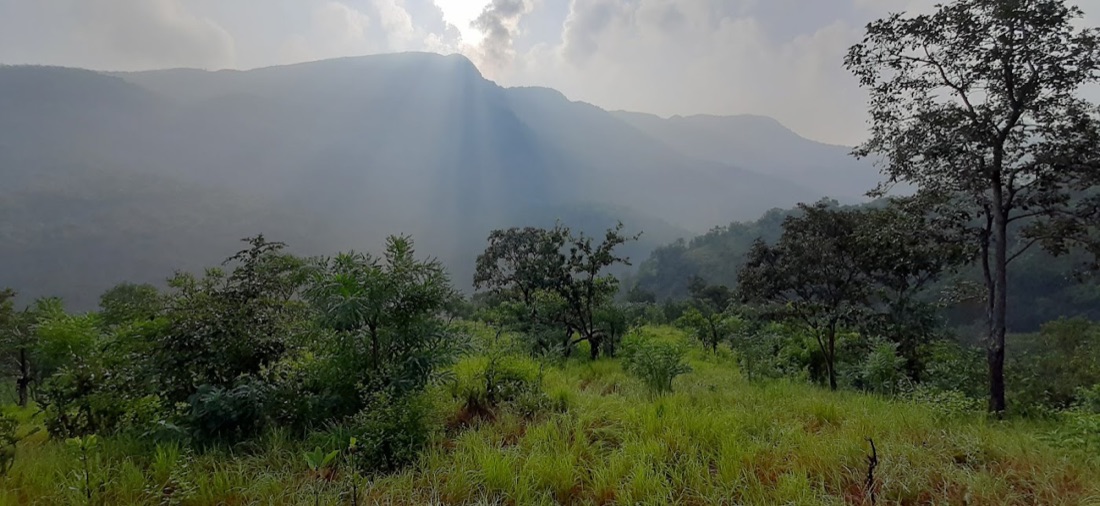
The hills near the farm, early morning.
Like many families from this region, ours has farming in its memory but not in its daily life.
Somewhere between our grandparents' generation and ours, food became something that arrives in a packet. The taste of a real naatu kodi curry, or a mango ripened on the tree, became a story older relatives tell.
We started Venkatagiri Hills Integrated Farm to close that gap, first for our own family and then for yours. Not by farming the modern way harder, but by farming an older way smarter: trees and animals together on the same land, each doing work the other needs.
Our job isn't to build an orchard. It's to bring life back underneath one.
We're lucky in one big way: we didn't have to start with bare earth. The heart of this farm is a mango orchard planted four decades ago, tall, wide-canopied trees that have been giving Alphonso, Banginapalli, Rumani, Neelam and Rasalu mangoes since before some of us were born.
Rayalaseema is dry, honest country. Farming here has never been easy, and the climate is making it harder. That's exactly why this model matters here: trees hold water and shade the soil, animals build fertility without bought inputs, and several kinds of income keep a small farm alive when one crop fails. If regenerative farming can work in Rayalaseema, it can work almost anywhere.
What we promise
- Honesty about our stage. We're young. Small batches, growing slowly. We'll never pretend to be a bigger, older farm than we are.
- No chemical shortcuts. The animals are the fertiliser plan and the pest-control plan. That's the whole point.
- Show, don't just tell. The journal, the photos and the open farm gate. Come and check anything we claim.
The journey
Where we've reached, and where we're going.
A farm is built in seasons, not sprints. Here's the honest map, including the parts that haven't happened yet.
-
The 1980s
Done
The orchard is planted
Four decades before us, these mango trees went into the red soil below the Venkatagiri hills. Today they stand tall and wide — a mature canopy that most new farms would have to wait a lifetime for.
-
2024
Done
The orchard's next chapter begins
We take charge of the 40-year-old orchard with a plan: keep the trees, bring in the animals, and turn a single-crop orchard into one living, integrated farm.
-
2025
Done
Readying the orchard floor
The unglamorous foundation year: fencing the boundary, clearing the undergrowth, refreshing drip lines, and feeding the old trees compost instead of chemicals.
-
Now — 2026
Happening now
Chickens join the orchard
Our first naatu kodi flocks are settling in among the young trees, with mobile night shelters and plenty of ground to forage. First eggs and birds are reaching customers.
-
Late 2026
Planned
Goats & sheep arrive
Hardy local breeds will join to browse and graze the orchard floor — nature's weed control and fertiliser team.
-
2027
Planned
The full cycle in motion
The first mango season grown entirely on the integrated system — old trees fed by the flocks and herds, with box deliveries of Alphonso and Banginapalli to cities across the region.
-
2028 and beyond
Planned
Farm stays & agritourism
Simple, comfortable stays under the mango canopy, so families can wake up on a working farm and see where their food comes from.